Custom software development in Riyadh
Cicada Solutions is a Riyadh software company that builds custom systems for Saudi businesses, with discovery done on your premises, progress you can click through every week, and the same team staying on after launch.
- 01Based in Riyadh
- 02Arabic and English, in the room
- 03Client-owned code and IP
- 04Weekly progress you can click
Most software projects fail at the brief, not in the code.
Saudi businesses rarely struggle to find developers. They struggle to find a team that understands the operation well enough to build the right thing, and stays long enough to make it work.
Remote teams never see the operation
Requirements written from a video call miss how the counter, the yard or the site actually works, and the gap shows up after launch.
Freelancers leave with the knowledge
A single developer builds the system, then moves on, and nobody else knows how it works or how to change it.
Large agencies sell a team you never meet
Senior people run the pitch, then the build passes to a team that has not been in your building or spoken to your staff.
Support disappears after launch
The system goes live, the first problems appear, and the people who built it are already on the next project.
From the first visit to a system your team runs every day.
Being in Riyadh changes how a project runs. Discovery happens on your premises, reviews happen in person when they matter, and support is not a time zone away.
Workshops in your office, time on your floor
We spend time where the work happens, with the people who do it, and map the workflow before anything is designed.
A prototype you click through before we build
Screens and flows are reviewed with your team in Arabic and English, and changed while changes are still cheap.
Working software every week
Each week ends with a demo of real progress, so priorities can move with the business instead of waiting for a big reveal.
Go live with your team, not just your IT
Training and launch happen with the people who use the system, and most first releases are live within four to eight weeks.
The same team stays on
The people who built the system maintain it, fix what appears in real use and plan the next release with you.
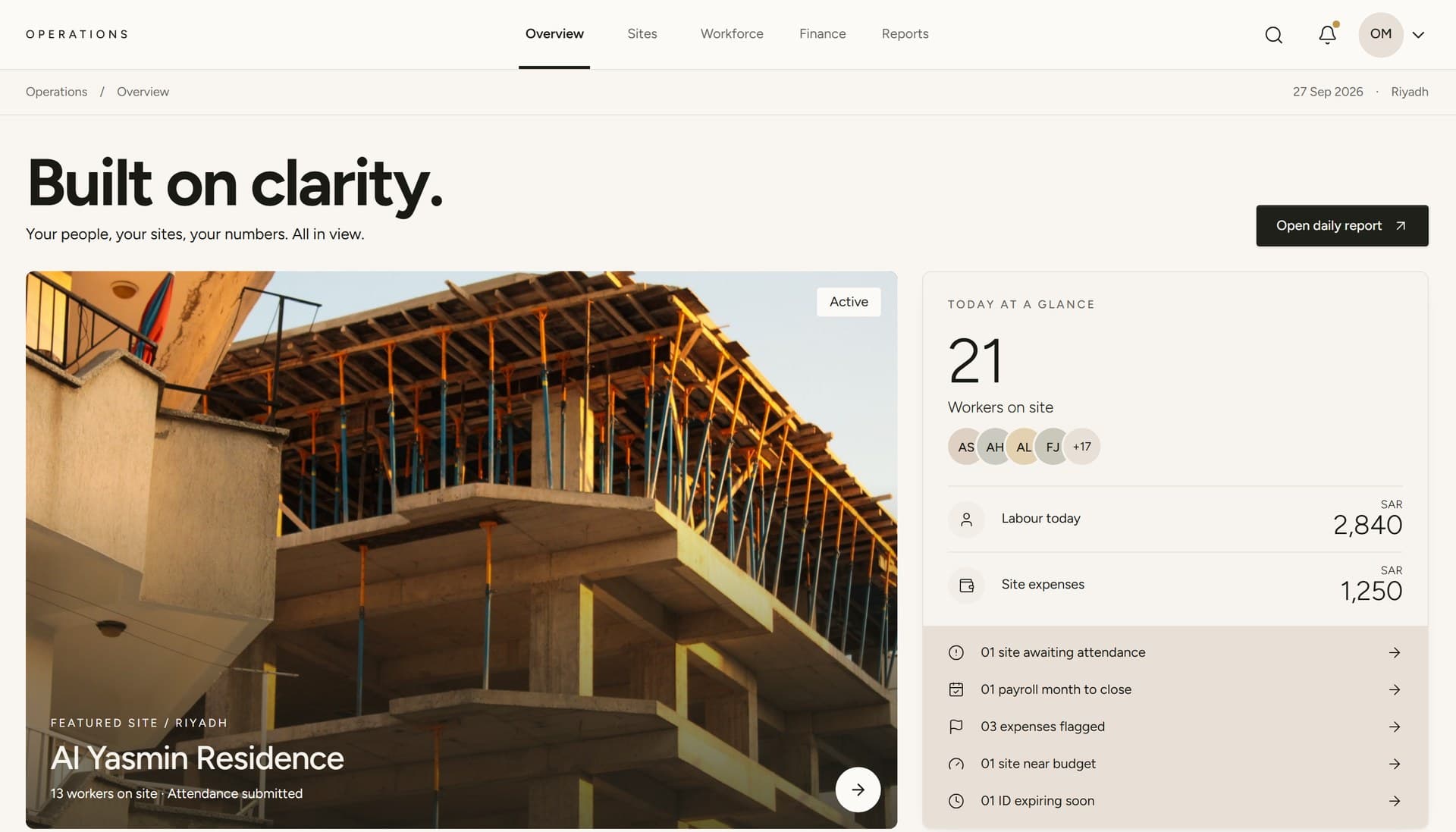
The screen is from SiteLedger, a workforce and site-cost platform Cicada built for a Riyadh general contractor, shown as published in its case study.
What the Riyadh team designs, builds and supports.
- Operational dashboards
- Customer and sales systems
- Booking and reservations
- ERP and inventory
- POS and invoicing
- HR and compliance
- Integrations and APIs
- Internal tools and portals
- Arabic and English interfaces
- Cloud or self-hosted deployment
Different projects need different engagement shapes.
A focused first release
One workflow, a clear scope and a fixed first release, so you see value before committing to more.
- Agreed scope and timeline
- Live in four to eight weeks
- Decide the next phase on evidence
An ongoing product team
A small team that keeps improving the system month by month, against a roadmap you set together.
- Monthly planning
- Weekly releases
- One team that knows the system
Rescue and takeover
An existing system that is unstable or abandoned, reviewed first, then stabilised, documented and improved.
- Code and risk review
- Stabilise before adding features
- Documentation and handover
Systems built to fit the Saudi tools around them.
Most projects connect to the same Saudi platforms and business tools. Knowing them well saves weeks in discovery and avoids surprises in testing.
The custom system
One record of truth. Each connection has an owner and a failure path.
- 01
ZATCA e-invoicing
Phase 2 integration with Fatoora, directly or through a compliant provider.
- 02
Qiwa, Mudad and GOSI
Contract, payroll and registration data from official exports or the access your establishment has.
- 03
Payments
mada, cards and Apple Pay through Saudi payment gateways and terminals.
- 04
WhatsApp Business
Notifications and customer messages through an approved provider, with consent recorded.
- 05
Accounting and ERP
The accounting or ERP system you already use, through its API or reliable exports.
- 06
Your existing data
Spreadsheets and older systems migrated cleanly, with validation before go-live.
Systems we have built, in use.
Our proof pages show real systems and real workflows rather than general claims, including work for a general contractor here in Riyadh.
Riyadh general contractor
SiteLedger
Mobile attendance, a worker register, site expenses, wages and reports for every site.
Open proof02Pool club management
Cue Control
Tables, reservations, check-in and revenue in one system the floor runs on.
Open proof03Rental operations
RentalOps
Availability, holds, mobilisation, maintenance and documents for fleet-heavy businesses.
Open proofJudge us by what you can see every week.
A good partner is measured on delivery, quality, adoption and how they behave when something goes wrong. Ask for these from any team you consider, including us.
Delivery
Measure whether the team ships what it promised.
- Weekly demos held
- Scope delivered per release
- Dates kept or renegotiated early
Quality
Measure how the software behaves in real use.
- Issues found after release
- Time to fix a reported problem
- Security and access reviewed
Adoption
Measure whether your team actually uses it.
- Active users after launch
- Workarounds and spreadsheets retired
- Training completed
Partnership
Measure how the relationship works.
- Response time to questions
- Documentation kept current
- Honest advice, including no
We agree delivery and support measures in the proposal, so both sides know what good looks like before work starts.
A Riyadh team is not always the right answer.
If your requirements are fully specified, stable and low-risk, an offshore team or a freelancer can deliver well for less. A Riyadh team earns its place when the work depends on understanding the operation, Saudi regulations and Arabic-speaking users, and when you need people who can be in the room.
| Decision | Offshore team or freelancer | Riyadh-based company |
|---|---|---|
| Discovery | From documents and video calls. | On your premises, with the people who do the work. |
| Saudi context | Learned during the project, if at all. | ZATCA, Qiwa, PDPL and Arabic interfaces are familiar ground. |
| Communication | Across time zones, usually in English only. | Same working week, in Arabic or English, in person when it matters. |
| Continuity | Depends on one person or a rotating team. | The team that built it supports it, with documentation you own. |
Answer the expensive questions before you sign.
Each page resolves one question businesses ask when choosing a software partner in Riyadh.
How to choose a software company in Saudi Arabia
What to ask, what to check and the warning signs in a proposal.
Open pageCustom software development in Saudi Arabia
The systems we build and how to decide which one you need first.
Open pageWhy Cicada Solutions
How the company works and what we will and will not take on.
Open pageCustom CRM development
Customer systems built around how Saudi sales and service teams work.
Open pageNCA cybersecurity controls
What the new national controls mean for the systems you commission.
Open pagePDPL enforcement brief
What the data protection law now expects from business software.
Open pageFrom a first conversation to a signed first release.
- 01
First conversation
A short call about the operation, the problem and what a useful first version would change.
- 02
Site visit
Time on your premises with the people involved, to see the workflow before proposing anything.
- 03
Written proposal
A phased scope, a first release with a timeline and cost, and the assumptions behind them.
- 04
First release
Design, weekly builds and launch of the first release with your team.
- 05
Support agreement
Agreed response times, maintenance and a plan for the next releases.
Contracts and IP
The client owns the custom code and IP by default, subject to the final agreement and clearly identified third-party services.
Data, hosting and security
Cloud or self-hosted deployment, including in-Kingdom hosting, assessed against PDPL and the NCA's cybersecurity controls.
Support
Documented systems, agreed response times and the same team on the other end of the phone.
Based in Riyadh. Working across the Kingdom.
Being in Riyadh means discovery happens in your office rather than over a call, and reviews can be in person when the decision matters. Cicada works with businesses in Riyadh and supports teams in Jeddah, Dammam, Khobar and across Saudi Arabia.
Practical answers before the first conversation.
01Can we meet the team in person?
Yes. Cicada is based in Riyadh, and discovery workshops and key reviews can take place at your premises.
02Do you work in Arabic?
Yes. Workshops, reviews, interfaces and documentation can be in Arabic, English or both, with right-to-left layouts designed properly rather than mirrored.
03How much does a custom system cost?
It depends on the workflows, users, integrations and data involved. We scope a useful first release after discovery and give a cost and timeline for it before you commit to more.
04How long until we see something working?
You see a clickable prototype early and working software every week. Most first releases go live in four to eight weeks after discovery.
05Can you take over a system someone else built?
Often, yes. We start with a review of the code, hosting and risks, then recommend whether to stabilise and extend it or replace parts of it.
06What happens after launch?
The team that built the system supports it under an agreed support plan, fixes what appears in real use and plans the next releases with you.
07Do we own the code and intellectual property?
Yes. Cicada Solutions' default position is that the client owns the code and IP for the custom build, subject to the final agreement and any clearly identified third-party services.
Tell us what you want to fix, and we will come and see it.
Describe the operation, the problem and what you have tried. We will respond with a practical starting point and, if it helps, a time to visit.
- What the business does and where
- The workflow or problem to fix first
- Tools and systems in use today
- Timing, budget range or deadlines